AI Fluency
The agent that knows you beats the model that's smarter than you
Your AI isn't Ten Second Tom. It's Lucy from 50 First Dates, and you're Henry. Here's how to build the tape: a memory substrate you own.
At a Glance
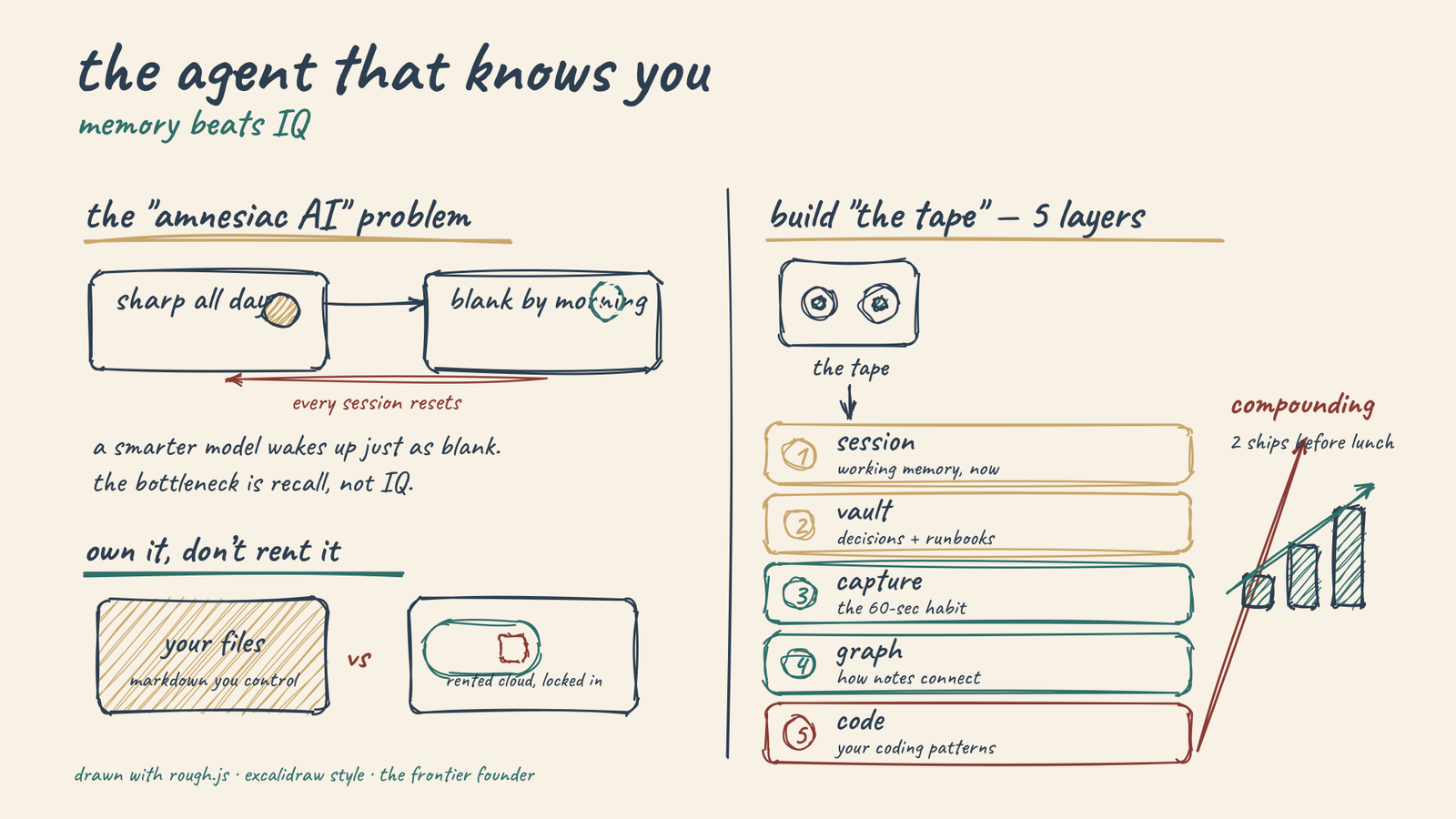
Your AI is Lucy from 50 First Dates, not Ten Second Tom: sharp all day, a blank slate by morning. Which makes you Henry, re-explaining your whole life before you can get anything done, every single day. This is the case for building the tape, a memory substrate you own, so your judgment compounds instead of resetting every session. It’s also a field report: the morning I shipped a 32-plugin marketplace and an open-source founder toolkit before lunch, because the tape did the remembering so I didn’t have to start cold.
Key Takeaways
- Your AI is brilliant inside a session and wakes up blank, the way Lucy resets every morning in 50 First Dates. The real bottleneck is recall.
- A smarter model doesn’t fix recall. The field’s actual fix is context engineering: designing the persistent context around every interaction (Sourcegraph, 2026).
- We learned it the hard way. 500 cold emails, zero replies, then 500 polished-identical AI rewrites. Reply rates on templated LLM outreach have collapsed under 1% (Zeliq, 2026).
- The fix is a memory substrate you own, five layers (session, vault, capture, graph, code), so the agent reads you back instead of meeting you cold. Where the memory lives decides who controls the compounding (ML6, 2026).
- Your move this week: clone the toolkit, run vault-setup, and end one session with a single captured decision. That’s the first frame of the tape.
The morning my AI lied to me about my own decision
Late May, a Tuesday. I asked Claude what I’d decided about our OpenRouter key rotation. It answered fast, clean, and sure of itself. It was also wrong. The answer contradicted DR-010, a decision record sitting in my own vault, in my own words, a few inches of disk away from the question.
The model did its job. The decision was right there in the vault, and the agent reached straight past it, because it couldn’t see the vault as memory. It read my notes the way you’d skim a stranger’s, loose paper on a desk instead of the thing it was supposed to already know.
If you’ve seen 50 First Dates, you already know the diagnosis. My AI is Lucy. Brilliant all day, genuinely present, funny, capable. Then it sleeps, the tape erases, and tomorrow it has never met me. Ten Second Tom, the side character who resets mid-handshake, would be a worse and more hopeless problem. A system that forgot every ten seconds couldn’t hold a thought long enough to be worth anything. Mine holds the whole day beautifully. The overnight wipe is what gets me.
So every morning I’m Henry. Here’s my product, my customer, what we decided last week, the tone I use. The movie has an entire diner reprinting the same newspaper and replaying Lucy’s favorite day so she never notices the loop. We do the same thing for our AI, feed it the same context every morning, and call it a workflow. I’d been running MoxyWolf as a venture studio for six months, treating Claude Code as my whole engineering org, and I was re-introducing myself to a brilliant amnesiac at the start of every session. The Tuesday it argued with DR-010 was the morning I stopped finding it charming.
Why won’t a smarter model fix this?
Because a smarter Lucy is still Lucy. A bigger model wakes up just as blank, only more articulate about not knowing you. The bottleneck was recall, never IQ.
The field has a name for the fix now, and it’s context engineering: designing the persistent information that surrounds every AI interaction (Sourcegraph, 2026). The constraint moved. Models got good enough that what’s binding is no longer how smart they are in the moment, it’s how much they actually know about you between moments (Atlan, 2026).
Watch what happens when you ignore that. Last quarter we sent 500 cold emails and got zero replies. Zero. So we did the reasonable thing and ran the list back through Claude with a “polish it” prompt. Back came 500 emails, every one grammatically pristine, every one semantically identical, every one instantly deletable. That was us being Lucy, painting the same portrait of Henry 499 times and proud of every one.
We weren’t bad at AI. We had a stack that mistook fluency for judgment. The market had already caught up to us: reply rates on templated, LLM-generated outreach have collapsed under 1%, because everyone’s pointing the same models at the same openers (Zeliq, 2026). A smarter model would’ve made our 500 emails more fluent. It would’ve done nothing about what it didn’t know, which was the prospect’s world, our real wins, and the one sentence only we could write.
I write all this toward a founder I’ll call Sarah. She runs a 28-person B2B services firm, and she’s about to run her own list through a “polish it” prompt and wonder why nothing lands. She isn’t bad at AI either, she just hasn’t built the reel yet.
That’s what AI fluency actually asks of a founder: judgment the machine can reach.
The bet: build the tape, and own it
The movie gets one thing right that most AI advice misses. Henry can’t make Lucy smarter, so he makes her a tape, the “Good morning Lucy” video she watches each day that catches her up on who she is, what happened, and who he is to her. Memory she can reload beats intelligence she can’t keep. The tape is the whole fix.
So here’s the bet I made that Tuesday, and I’d defend it in front of a hostile reviewer. The agent that knows you is worth more than the model that’s smarter than you. And the only way to build the agent that knows you is to own the substrate it remembers in. Build the tape.
“Own” is doing real work in that sentence. You can rent memory. Every platform will happily hold your tape for you, on their disk, in their format, played back the way they decide, gone the day you leave. That archive becomes the platform’s moat, with your life sitting inside it. The case for sovereign, portable memory comes down to one line: where the memory lives decides who controls the compounding (ML6, 2026).
So mine lives in a folder I own. Markdown files, cloud-synced, readable by any model I point at them. Boring on purpose. The boring part is the point, because a boring tape is the one that still plays after you swap the model.
What are the five layers, and why not ten?
The substrate is five layers, each a different kind of remembering: session, vault, capture, graph, and code. A good tape isn’t just “here’s the accident, here’s your boyfriend.” Lucy’s early reels were crude. The ones that worked were edited, sequenced, indexed. So is mine. Five layers:
- The session. Working memory for whatever I’m in right now. It’s gone when I close the tab, the way Lucy’s day is gone by morning, and that’s fine, as long as anything I decided flows down before it disappears.
- The vault. The durable layer. Decisions, runbooks, the reasons behind the reasons. The “what I chose and why” that DR-010 lives in. This is the tape itself.
- Capture. A 60-second habit at the end of a session: what did I decide, what changed my mind, what’s next. It records tonight’s footage so tomorrow’s playback has it.
- The graph. The connective tissue. It reads the whole vault and builds the map, so the agent can answer “what connects to this” without re-watching every minute of footage.
- Code memory. It pulls patterns out of my repos, so the agent already knows how I write code instead of waiting for me to re-explain my conventions on every project.
The layers weren’t the hard part. The hard part was teaching the agent which layer to reach for which question, the difference between “remind me who I am” and “remind me what connects to this.” That meta-knowledge had to live somewhere it could read, so I rewrote two runbooks from scratch the day I shipped. Without them, five layers is five unlabeled tapes, and you’re back to watching all of them every morning. Which, granted, still beats the ten layers nobody asked for.
What did owning the tape buy me before lunch?
Two shipped products in a single morning. A number, since I promised the hostile reviewer one.
On June 26, 2026, before lunch, I shipped twice. In the morning, MoxyWolf marketplace v1.16.0: thirty-two plugins, thirty-one of them mine, commit c09f14d. An hour later, the Frontier Founder Toolkit v0.1.0, to a brand-new org I’d created that same morning, OpenControls-AI. Forty-two files, about four thousand lines, Apache-2.0, commit 9280072.
I could move that fast for one reason. The agent watched the tape before I sat down. It woke up already knowing the conventions, the prior decisions, the voice, so I never spent the morning being Henry. The remembering was done. I just had to do the judging.
The toolkit is those five layers, stripped to what a founder needs on day one: vault-setup, obsidian-update-lite, vault-code-learn, graphify, and excalidraw-vault, because half of what I figure out only makes sense as a sketch. I put it under Apache-2.0 on purpose, patent grant and all. Anyone can publish a manifesto about AI governance not being a moat for the big platforms. A working toolkit you can fork is a manifesto with a receipt.
What’s your move this week?
Back to Sarah. The toolkit won’t fix her cold-email problem, and I won’t pretend it will. What it does is give her judgment a place to compound instead of getting smoothed flat by the next “polish it” prompt. The work she does once, the agent keeps. She stops repainting the same portrait.
If you want to start, start small enough that you’ll actually finish. Clone the Frontier Founder Toolkit. Run vault-setup. Then end one real working session, today, with a single captured decision. One record. Call it the first frame of the tape. The compounding starts the second time the agent reads back something you’d have re-typed.
The README has a line I almost cut and then kept: if you’re looking for a framework, this isn’t one. If you’re looking for working files, you’re in the right place.
And unlike Henry, you only have to make the tape once.
Read the full AI Fluency for Founders series →
One honest caveat
A substrate is upkeep, not a trophy. A vault left alone turns into a swamp: stale notes, dead links, decisions that quietly contradict each other. The five layers only compound if you actually run the capture habit and prune now and then. The toolkit hands you the structure. The discipline is still yours. Skip the end-of-session record for a week and you don’t have a memory, you have a folder.
Frequently asked questions
Why does my AI forget everything between sessions?
Models are stateless between sessions. They hold context beautifully inside one conversation and start blank in the next, and a bigger model wakes up just as empty. The fix is persistent context you supply on purpose, what the field now calls context engineering.
Is my AI tool’s built-in memory enough, or do I need my own?
Built-in memory is convenient, but it lives on the vendor’s disk, in their format, played back the way they decide, and gone the day you leave or they change terms. Owning the substrate, plain files you control, keeps the compounding yours and portable across whatever model you point at it next.
What are the five memory layers?
Session (working memory for right now), vault (durable decisions and runbooks), capture (the 60-second end-of-session habit that writes records), graph (the map of how your notes connect), and code memory (your coding patterns pulled from your repos). The real trick is teaching the agent which layer to reach for which kind of question.
Do I have to set up all five layers on day one?
No. Start with the vault and the capture habit. One captured decision is the whole on-ramp. The graph and code layers earn their keep later, once you have enough notes worth connecting.
What is the Frontier Founder Toolkit?
An Apache-2.0, open-source set of five plugins (vault-setup, obsidian-update-lite, vault-code-learn, graphify, excalidraw-vault) that scaffold the substrate so a founder can start on day one. Clone it, run vault-setup, then end one real session with a single captured decision.
Sources retrieved 2026-06-26.