AI Strategy
Darwin or the Leap: How AI Will Change Your Company
AI tools spread gradually, but the work changes in bursts. My bet is it jumps when decisions move. See the evidence, then test it before your budget gate.
By Dorian Cougias · Published October 5, 2026 · Last updated October 5, 2026
Is AI change gradual or punctuated? Both, describing different things. The tools spread gradually, Darwin’s way, while the work changes in bursts when it’s redesigned, Eldredge and Gould’s way. My bet is that the burst comes when decisions move, so where you bet decides whether you buy seats or change who decides.
At a Glance Darwin said natural selection “can never take a leap.” Eldredge and Gould said species mostly sit still, then leap. The spread is Darwin’s and the work has barely moved: copilots across 66 firms saved about two hours of email a week and left task mix unchanged (Dillon et al., NBER, 2025). Change in the work looks punctuated: in 25 minicomputer makers, most transformations came in bursts and small changes didn’t add up (Romanelli and Tushman, Academy of Management Journal, 1994). My bet is that the payoff comes from moving decisions.
Key takeaways
- Two theories of change are fighting over AI. Gradualism says small improvements pile up. Punctuated equilibrium says long stillness ends in sudden jumps.
- The tools spread the way Darwin said traits spread, gradually. The work doesn’t follow: seat-by-seat tools save time without changing what people work on (Dillon et al., NBER, 2025).
- Change in the work looks punctuated. Electric motors took two decades to reach half of US factory mechanical drive, but productivity only jumped once plants were redesigned around it (David, American Economic Review, 1990).
- My hypothesis is that the jump comes when decisions move, and the units that survive it tend to have ties to the core, not walls (Hill and Birkinshaw, Journal of Management, 2014).
- So stop waiting for seats to add up. Change who decides, and treat the whole design as a hypothesis until someone tests it on AI.
Who’s at the bar, and what are they fighting about?
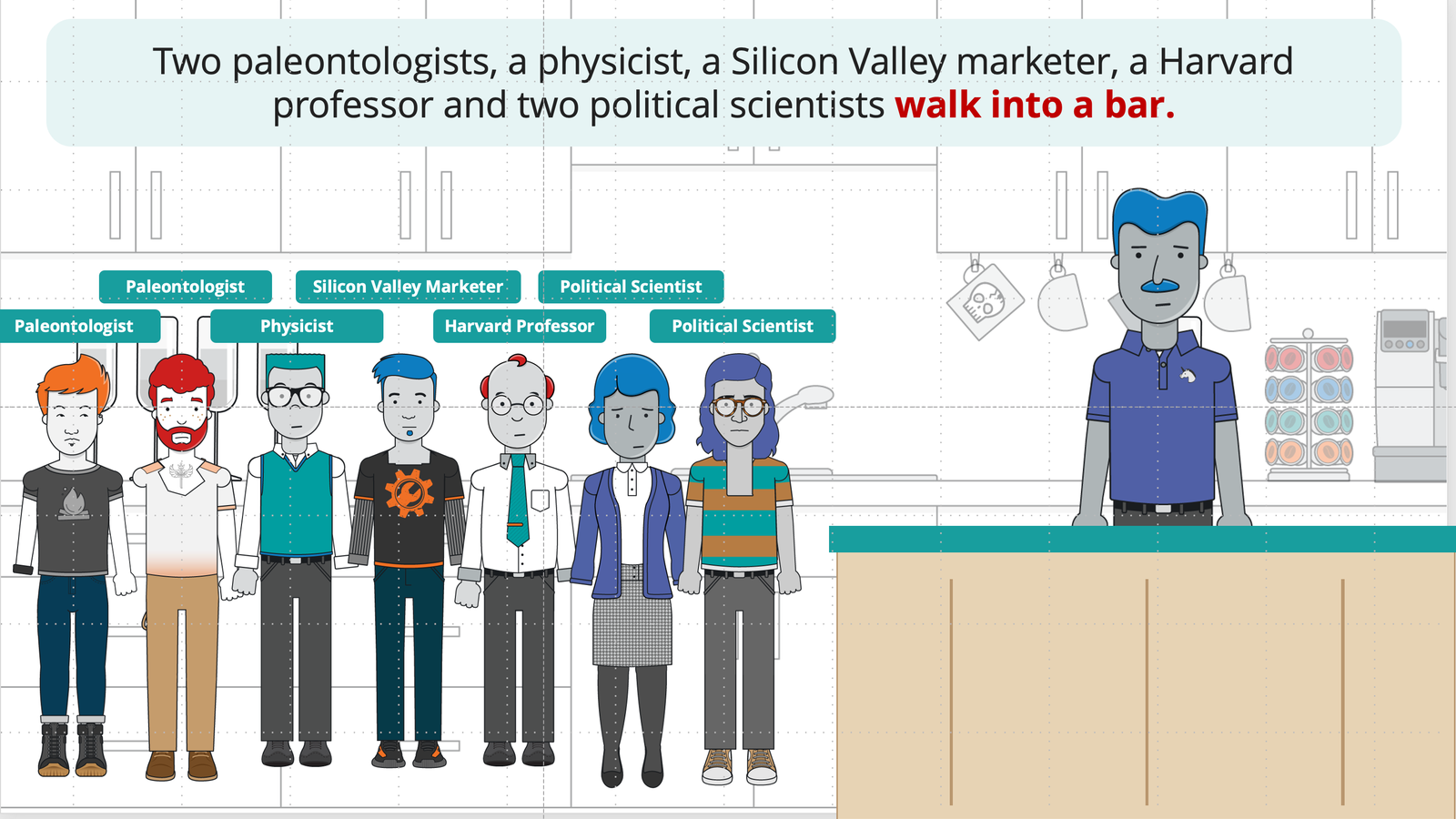
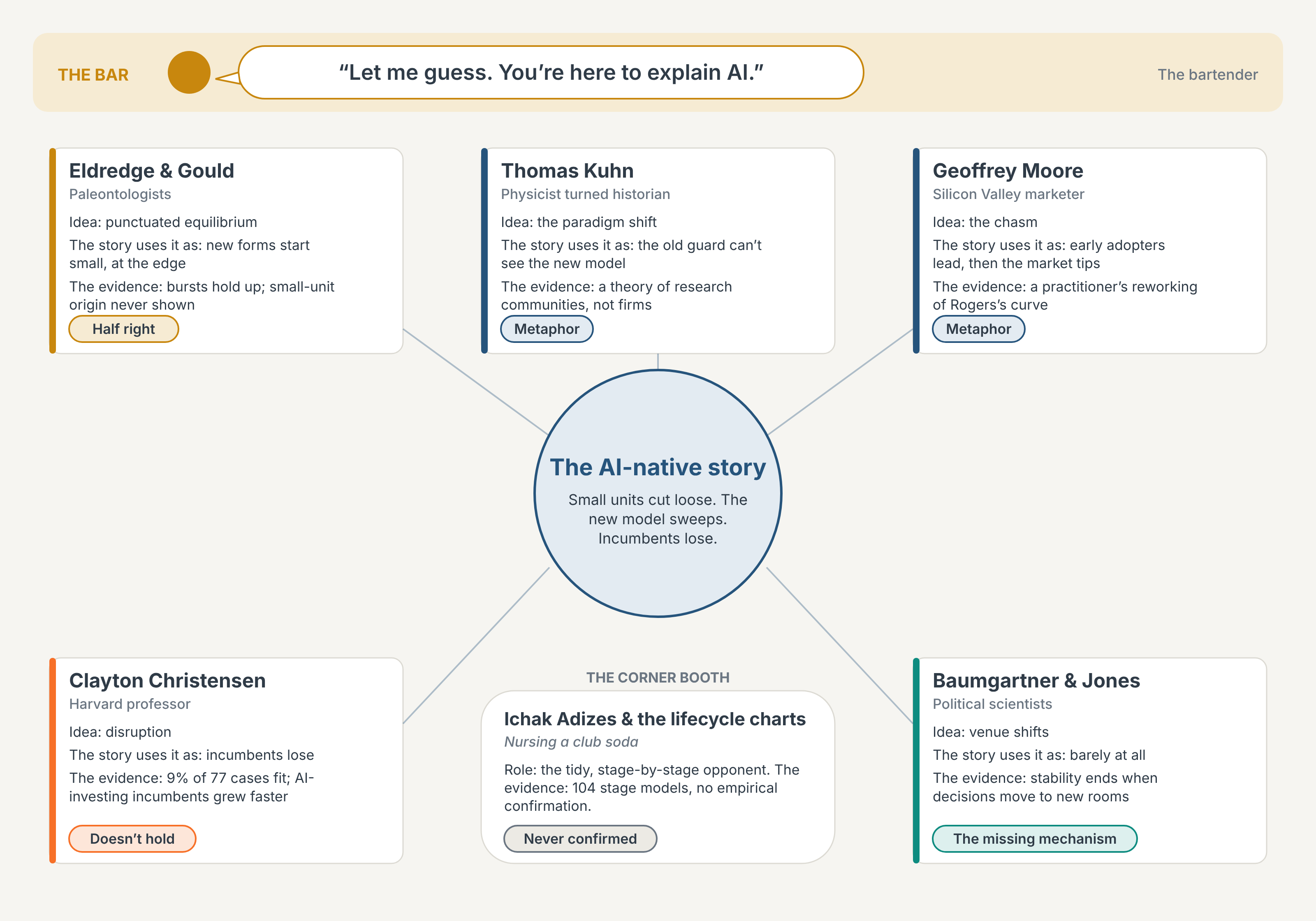
Two paleontologists, a physicist, a Silicon Valley marketer, a Harvard professor and two political scientists walk into a bar. The bartender looks up and says, “Let me guess. You’re here to explain AI.”
They’re arguing over the oldest question in evolution: does change creep or leap? In 1859 Darwin wrote that natural selection “can never take a leap, but must advance by the shortest and slowest steps” (Darwin, On the Origin of Species, 1859). In 1972 Niles Eldredge and Stephen Jay Gould titled their answer “Punctuated Equilibria: An Alternative to Phyletic Gradualism.” Species sit still for ages, they argued, then change fast in small groups out at the edge of their range (Eldredge and Gould, 1972).
Business has been running the same fight ever since, mostly without noticing. The gradual camp gave us Everett Rogers’s smooth diffusion curve and the idea that good companies change continuously, in rhythm, a little at a time (Brown and Eisenhardt, Administrative Science Quarterly, 1997). That’s the theory behind every seat-by-seat copilot rollout.
Notice who isn’t at the bar: Darwin, Rogers, Brown and Eisenhardt. Everyone who is belongs to the punctuated camp. Thomas Kuhn, the physicist turned historian, said science lurches from one shared worldview to the next (Anand, Larson and Mahoney, Production and Operations Management, 2020). Geoffrey Moore, the marketer, took Rogers’s smooth curve and carved a chasm into it, a cliff Rogers’s own research never found (Henderson, Legal Evolution, 2017). Clayton Christensen, the Harvard professor, showed disk-drive leaders losing each time drives shrank, because they kept listening to their best customers (Christensen and Bower, Strategic Management Journal, 1996). And Frank Baumgartner and Bryan Jones, the political scientists, took punctuated equilibrium out of the fossil record and found it in government. Connie Gersick showed the same pattern turning up in six different fields, from group development to the history of science (Gersick, Academy of Management Review, 1991).
I know this bar. Those books are on my shelf.
The reading started with Dr. Riman Rotz’s honors classes at the University of Chicago. In 1980 I sat in the Field Museum of Natural History while Dr. Raup and Dr. Cracraft brought Eldredge and Gould in to lecture, and I walked out with an idea I’ve never put down: change doesn’t creep. It waits, then it jumps. Decades later, Baumgartner and Jones asked my team at Unified Compliance to provide the regulatory mapping for one of their studies. It’s not every day the people who wrote the book ask for your map.
So when AI showed up and everyone started borrowing my shelf, mostly as metaphor, I wanted to know which side of the bar the evidence sits on. It matters if you’re someone like Dana (call her a composite): COO of a 2,000-person company, a copilot-seat quote and an AI skunkworks pitch on her desk, six weeks to the budget gate. The copilot quote is a Darwinian bet. The skunkworks is a punctuated one.
What does the gradual camp get right?
At the desk, the spread is Darwin’s and the work has barely moved. Across 66 firms and 7,137 knowledge workers, people with an AI assistant spent about two fewer hours a week on email, and the mix of their tasks didn’t move (Dillon et al., NBER, 2025). Danish chatbot users saw precise null effects on earnings and hours (Humlum and Vestergaard, NBER, 2025).
The gradual camp’s business theory explains why. Rogers’s diffusion curve says a good idea spreads person to person until it’s everywhere. Brown and Eisenhardt’s most successful computer-industry units changed all the time without a revolution: light structure, lots of cheap probes into the future, and a steady rhythm of transitions (Brown and Eisenhardt, Administrative Science Quarterly, 1997). To Dana, that camp says buy the seats, run lots of small pilots, and let the good ones spread.
Adoption creeps the same way. By May 2026, 37% of US firms with 250 or more employees reported using AI, while use among firms under 20 employees barely moved (US Census Bureau, 2026). That’s a diffusion curve doing what diffusion curves do.
History says don’t confuse the curve with the payoff. Electric motors supplied under 5% of US factory mechanical drive in 1899 and took about two more decades to reach half. Manufacturing productivity didn’t feel it until the early 1920s (David, American Economic Review, 1990). The spread was gradual. The gain was not.
Darwin had a line for a company’s AI pilot portfolio, too. Borrowing from the zoologist Milne Edwards, he wrote that nature is “prodigal in variety, but niggard in innovation” (Darwin, 1859). That’s most AI pilot lists: lots of variety, little that’s new.
So Dana’s copilot quote buys email savings. It doesn’t buy a new operating model.
What does the punctuated camp get right?
Organizations transform in jumps. When Elaine Romanelli and Michael Tushman followed 25 US minicomputer makers, most transformations changed strategy, structure and power together in short bursts, and small changes didn’t add up to fundamental ones (Romanelli and Tushman, Academy of Management Journal, 1994). The triggers were big shifts in the environment and a new CEO, not a bad quarter.
Read that middle finding twice. Small changes didn’t add up. That’s the gradualist bet, tested, and it lost.
Government shows the same shape. Budget changes across Western democracies are mostly small adjustments punctuated by a few large changes, larger where institutions carry more friction (Jones et al., American Journal of Political Science, 2009). Across 3,581 US federal spending changes from 1947 to 2009, 360 were punctuations (Baumgartner and Epp, Comparative Agendas Project, 2013).
Any operator will recognize the shape. Approval layers, sign-off chains and annual budget gates store change up and release it all at once, like a dam with a procurement policy. My hypothesis is that firms with more of that friction sit flatter, then jump harder.
In government, what breaks the dam is a venue shift. In Baumgartner and Jones’s account, a policy area stays stable while one group controls how the issue is understood and where it gets decided. Nuclear power is the classic case. In the 1950s, two congressional committees held five hearings on it. By the 1970s, fourteen committees held more than fifty (Baumgartner and Jones, 1993, summarized by NCCHPP, 2018). The industry lost because the decisions moved to rooms it didn’t control.
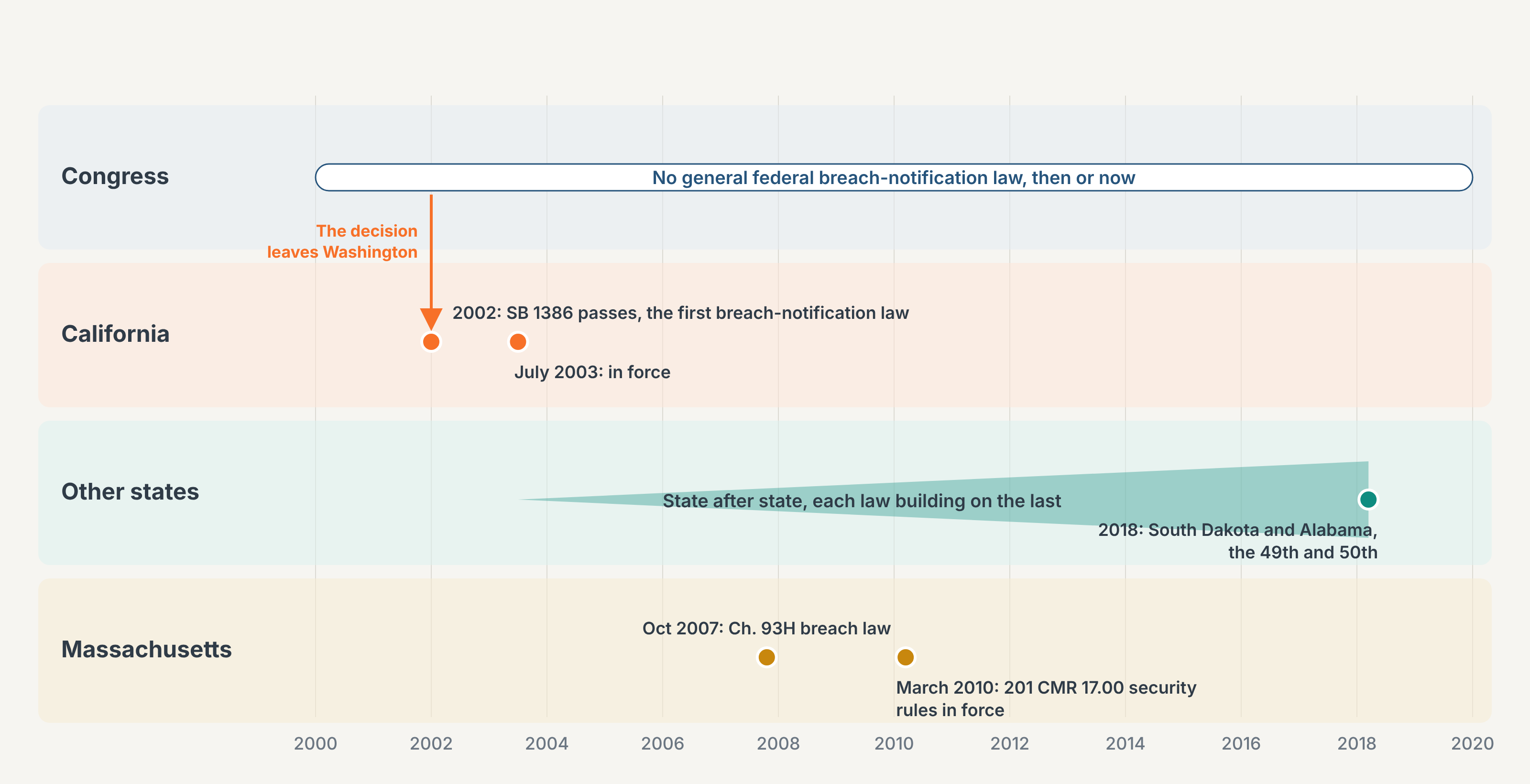
I didn’t need the nuclear hearings to believe it. I watched the same thing in privacy law, and my team mapped it as it went. Congress never passed a general data-breach law. California did, with SB 1386, approved in 2002 and operative in July 2003. State after state followed, each law building on the one before, and Massachusetts set the high-water mark with its 2010 security rules. In 2018 South Dakota and Alabama made it fifty (Privacy Rights Clearinghouse, 2022). Notice the shape. California was the punctuation, a venue shift. The states that followed, each copying and building on the last, were Darwin. It’s one practitioner’s map, so read it as a field note.
Here’s what that means inside a firm. Call a venue the place where a class of AI decisions gets made, plus the person who answers for them. In most established companies that’s the approval chain, and it plays the nuclear industry’s part. The firm doesn’t. This is where the analogy bends. Nuclear power’s decisions moved to committees the industry didn’t run. A firm moves its decisions itself, out of its own chain and into a room it builds. The chain loses control of them, but control never leaves the firm. It just changes rooms. Policy science shows outsiders taking control of who decides. That a firm can make the same break on purpose, from inside, is my hypothesis, not a finding. And a move like that can run in reverse. In government the arc has been burst, defense, backlash (Jones, Theriault and Whyman, University of Chicago Press, 2019).
So is AI change gradual or punctuated?
Both, describing different things. The tools spread gradually. The work changes in jumps when a company redesigns it. Whether moving decisions is what sets the jump off is my hypothesis. Electric motors spread through US factories for two decades, but productivity only jumped in the 1920s, once plants were redesigned around them (David, American Economic Review, 1990).
One honest step in the logic. Neither David nor Romanelli and Tushman measured decision rights directly. They measured redesign: new plant layouts, and strategy, structure and power changing together. Reading that redesign as a change in who decides is my inference, and it’s the part that still needs testing.
Even at the seat, how the tool sits in the work matters. Built into the workflow of 5,172 support agents, an AI assistant raised issues resolved per hour by 15% (Brynjolfsson, Li and Raymond, Quarterly Journal of Economics, 2025). General-purpose seats saved email time and little else.
The popular version of the punctuated story gets one thing wrong. It says the jump will come from outside, with AI-native startups wiping out slow incumbents. So far the data points the other way. AI-investing firms grew faster, with the gains concentrated among larger firms, though that evidence predates generative AI (Babina et al., Journal of Financial Economics, 2024). And when researchers checked the 77 cases Christensen and his co-authors offered as disruption, only 9% showed all four features, and in 39% the incumbents survived or thrived (King and Baatartogtokh, MIT Sloan Management Review, 2015).
The punctuation is real, and so far it shows up inside companies that redesign the work. My bet is that moving decisions is what sets it off. That’s the part still to be tested.
Where the jump starts: who decides, with ties
My bet is that the jump starts where decisions move. What the evidence does show is that the units carrying change survive on ties, not isolation. Of 95 corporate venture units surveyed in 2001, 22 had closed by December 2003, and survival tracked ties to parent executives, business-unit managers and venture capitalists (Hill and Birkinshaw, Journal of Management, 2014).
That’s where the biology misleads. Eldredge and Gould put new species in small groups cut off at the edge of the range, and the AI story borrows that as “cut a skunkworks loose.” The venture study measures association, so it can’t prove walls cause closure. Romanelli and Tushman’s firms also changed when who decided changed, though their version was a new CEO, which a real test has to separate from a new venue. Ties over walls also fits Saturn, which GM launched as an entirely new kind of car company and then slowly starved (Knowledge at Wharton, 2009). Saturn had walls and a new logo, and that was most of the plan.
What should you do before the next budget gate?
Run a small version of the test inside your own company. It can’t show whether change comes as a step or a ramp, but it can compare levels. Fund one unit that owns its decisions, keep a seat-only rollout to compare, and measure both on two metrics set in advance. Of 35 breakthrough efforts, the ones run as separate units tied in at the senior team hit their goals more than 90% of the time (O’Reilly and Tushman, Harvard Business Review, 2004).
The authors picked those 35 cases themselves, so treat the number as a direction to test, which is the point. For Dana, the budget request carries three things: a named senior sponsor, a separate budget line for the unit, and the two metrics, such as cycle time and task mix on one workflow.
One more piece, and it’s my proposal, not a finding. When you move decisions, keep a name on them. In my own earlier working paper I call it governed autonomy: size the gate to the stakes, put a named human above the loop rather than inside every step, record who or what took each consequential action, and audit how often the gate says no (Cougias, MoxyWolf working paper, 2026). None of the research above tests it. It’s how I’d try to keep the new room from being pulled back after its first failure.
Then read the results after four quarters. This test compares seats with a unit that owns its decisions. It can’t tell you whether the governed-autonomy rules helped.
- If the seat-only side matches the unit, moving decisions isn’t buying you anything yet. Buy more seats and keep the pilots small.
- If the unit pulls away, the decisions are where the value is. Move more decisions to it, and give it a path back so its workflows get adopted by core teams.
- If the unit stalls, check its ties before you blame the idea.
A license count tells you what you bought. It doesn’t tell you what changed. That’s the Frontier Founder bet: build AI into how decisions get made.
What I don’t know yet
Nobody has run the gradual-versus-punctuated test on AI. I checked whether public documents could stand in for it. They can’t. In a convenience sample of ten firms that publicly claimed big AI gains in a named workflow, I found self-reported results and often a named AI group, but not one dated handover of approval rights followed by a measured change in the work. That’s missing evidence, not ten disconfirmations. The test needs internal records. The best organizational evidence is 25 minicomputer makers founded in the late 1960s and a single 2001 cohort of corporate venture units, so my answer is a hypothesis (Romanelli and Tushman, Academy of Management Journal, 1994).
The gradual camp could still win. If seat-level gains compound as the models get better, the slow steps might add up after all, the way Brown and Eisenhardt’s most successful computer-industry units kept changing without a revolution. The same Danish study finds tasks starting to reorganize while pay and hours sit still (Humlum and Vestergaard, NBER, 2025).
Here’s the test that would settle it. Follow 100 established firms for 24 months. Compare the ones that only buy seats with the ones that move decisions, on metrics registered in advance, and track every unit that closes. If the seat-buyers show the same change in the work, in task mix and cycle time, moving decisions doesn’t matter. If change in the work is no lumpier than a gradual process would produce, Darwin wins. Count the failures, or you’re just interviewing survivors. I lay out six hypotheses and one labeled proposal, what would prove each wrong, and every source in the full essay. Prefer to watch? Here’s the video version.
FAQ
Is AI change gradual or punctuated?
Both, describing different things. AI tools spread gradually, and seat-by-seat use has shown small effects, like two hours of email saved a week across 66 firms (Dillon et al., NBER, 2025). The large gains come in bursts when companies redesign work, the pattern Romanelli and Tushman found in organizational transformations (Academy of Management Journal, 1994). Whether moving decisions is the trigger is still a hypothesis.
What is punctuated equilibrium in business?
It’s the idea that organizations stay stable for long stretches and then change strategy, structure and power together in short bursts. Eldredge and Gould proposed it for evolution in 1972, and Connie Gersick traced the same pattern across six fields in a 1991 Academy of Management Review article.
Do enterprise copilot rollouts improve productivity?
Seat-by-seat rollouts of general tools have shown small effects so far. A 66-firm experiment found about two hours of email saved a week with no change in what people worked on (Dillon et al., NBER, 2025). Gains show up where the tool is built into a specific workflow, like the 15% lift for customer-support agents (Brynjolfsson, Li and Raymond, Quarterly Journal of Economics, 2025).
Should I build a separate AI skunkworks?
Only if it has strategic ties back to the core. Separate units integrated at the senior team hit their goals in more than 90% of cases in O’Reilly and Tushman’s 2004 Harvard Business Review study of 35 breakthrough efforts. My hypothesis is that it also needs real decision rights. A unit with walls and no ties is how GM’s Saturn happened.
What is a venue shift?
A venue shift is when decisions about an issue move to a forum the old guard doesn’t control. Political scientists Frank Baumgartner and Bryan Jones showed it ends long periods of policy stability. For an AI unit, it would mean the unit actually decides budget and workflow, rather than advising a core that decides. Whether that works inside a firm the way it works in government is the hypothesis the essay designs a test for.
Part of The Frontier Founder. Read the full series →
Sources
Each source below was retrieved October 4 or 5, 2026. The full list, 60 sources and two statutes plus one working paper of mine, is in the essay.
- Anand, G., Larson, E. C. and Mahoney, J. T. (2020). Thomas Kuhn on paradigms. Production and Operations Management. https://doi.org/10.1111/poms.13188 Retrieved October 4, 2026.
- Babina, T., Fedyk, A., He, A. and Hodson, J. (2024). Artificial intelligence, firm growth, and product innovation. Journal of Financial Economics. https://doi.org/10.1016/j.jfineco.2023.103745 Retrieved October 4, 2026.
- Baumgartner, F. R. and Epp, D. A. (2013). Explaining punctuations. Comparative Agendas Project annual meeting, Antwerp. https://fbaum.unc.edu/papers/Baumgartner-Epp-CAP-2013.pdf Retrieved October 4, 2026.
- Baumgartner, F. R. and Jones, B. D. (1993). Agendas and Instability in American Politics. University of Chicago Press. Summarized in Masse Jolicoeur, M. (2018), National Collaborating Centre for Healthy Public Policy. https://www.ncchpp.ca/docs/2018_ProcessPP_Intro_PunctuatedEquilibrium_EN.pdf Retrieved October 4, 2026.
- Brown, S. L. and Eisenhardt, K. M. (1997). The art of continuous change. Administrative Science Quarterly. https://iacmr.org/wp-content/uploads/sites/26/2024/05/2.1997-Brown-Eisenhardt-The-art-of-continuous-change.pdf Retrieved October 4, 2026.
- Brynjolfsson, E., Li, D. and Raymond, L. (2025). Generative AI at work. The Quarterly Journal of Economics. https://doi.org/10.1093/qje/qjae044 Retrieved October 4, 2026.
- California Legislature (2002). Senate Bill 1386, Chapter 915. https://leginfo.ca.gov/pub/01-02/bill/sen/sb_1351-1400/sb_1386_bill_20020926_chaptered.pdf Retrieved October 4, 2026.
- Christensen, C. M. and Bower, J. L. (1996). Customer power, strategic investment, and the failure of leading firms. Strategic Management Journal. https://www.hbs.edu/faculty/Pages/item.aspx?num=2532 Retrieved October 4, 2026.
- Commonwealth of Massachusetts (2010). 201 CMR 17.00: Standards for the protection of personal information. https://www.mass.gov/doc/201-cmr-17-standards-for-the-protection-of-personal-information-of-residents-of-the-commonwealth/download Retrieved October 4, 2026.
- Cougias, D. (2026). Governed autonomy: Human accountability above the loop in agentic AI. MoxyWolf LLC working paper. https://doi.org/10.13140/RG.2.2.33030.74565 Retrieved October 5, 2026.
- Darwin, C. (1859). On the Origin of Species, first edition. Project Gutenberg. https://www.gutenberg.org/ebooks/1228 Retrieved October 5, 2026.
- David, P. A. (1990). The dynamo and the computer. American Economic Review. https://gwern.net/doc/economics/automation/1990-david.pdf Retrieved October 4, 2026.
- Dillon, E. W., Jaffe, S., Immorlica, N. and Stanton, C. T. (2025). Shifting work patterns with generative AI. National Bureau of Economic Research, Working Paper 33795. https://www.nber.org/papers/w33795 Retrieved October 4, 2026.
- Eldredge, N. and Gould, S. J. (1972). Punctuated equilibria: An alternative to phyletic gradualism. In Models in Paleobiology, Freeman, Cooper. https://www.blackwellpublishing.com/ridley/classictexts/eldredge.asp Retrieved October 4, 2026.
- Gersick, C. J. G. (1991). Revolutionary change theories. Academy of Management Review. https://doi.org/10.5465/amr.1991.4278988 Retrieved October 4, 2026.
- Henderson, B. (2017). Crossing the chasm and the hype cycle, part III. Legal Evolution. https://www.legalevolution.org/2017/09/crossing-the-chasm-and-the-hype-cycle-part-iii-026/ Retrieved October 4, 2026.
- Hill, S. A. and Birkinshaw, J. (2014). Ambidexterity and survival in corporate venture units. Journal of Management. https://doi.org/10.1177/0149206312445925 Retrieved October 4, 2026.
- Humlum, A. and Vestergaard, E. (2025). Still waters, rapid currents: Early labor market transformation under generative AI. National Bureau of Economic Research, Working Paper 33777. https://www.nber.org/papers/w33777 Retrieved October 4, 2026.
- Jones, B. D., Baumgartner, F. R. et al. (2009). A general empirical law of public budgets. American Journal of Political Science. https://doi.org/10.1111/j.1540-5907.2009.00405.x Retrieved October 4, 2026.
- Jones, B. D., Theriault, S. M. and Whyman, M. (2019). The Great Broadening. University of Chicago Press. https://press.uchicago.edu/ucp/books/book/chicago/G/bo38181724.html Retrieved October 4, 2026.
- King, A. A. and Baatartogtokh, B. (2015). How useful is the theory of disruptive innovation? MIT Sloan Management Review. https://sloanreview.mit.edu/article/how-useful-is-the-theory-of-disruptive-innovation/ Retrieved October 4, 2026.
- Knowledge at Wharton (2009). At least it’s still a planet. University of Pennsylvania. https://knowledge.wharton.upenn.edu/article/at-least-its-still-a-planet/ Retrieved October 4, 2026.
- O’Reilly, C. A., III and Tushman, M. L. (2004). The ambidextrous organization. Harvard Business Review. https://hbr.org/2004/04/the-ambidextrous-organization Retrieved October 4, 2026.
- Privacy Rights Clearinghouse (2022). Data breach notification in the United States: 2022 report. https://privacyrights.org/resources/data-breach-notification-2022 Retrieved October 4, 2026.
- Romanelli, E. and Tushman, M. L. (1994). Organizational transformation as punctuated equilibrium: An empirical test. Academy of Management Journal. https://doi.org/10.5465/256669 Retrieved October 4, 2026.
- US Census Bureau (2026). Large firms with at least 20 employees biggest AI users. America Counts. https://www.census.gov/library/stories/2026/05/ai-use-businesses.html Retrieved October 4, 2026.
Media gallery